Built to Last: Protect Your Steel – and Your Profits – in South African Fabrication
Built to Last: Protect Your Steel – and Your Profits – in South African Fabrication
In South Africa’s steel fabrication and structural engineering sectors, maintaining traceability from the workshop floor to the final job site is a high-stakes challenge. Steel is not just a raw material—it is a regulated asset tied directly to safety, compliance, and profitability.
Yet in many operations, traceability breaks down under real-world conditions.
Standard labels melt under heat. Paper tags tear during handling. Handwritten paint markings disappear beneath galvanising or heavy coatings. When identification fails, production slows, rework increases, and costly mistakes—such as incorrect deliveries or rejected components—put contracts and reputations at risk.
And the stakes are high:
- South Africa consumes over 3 million tonnes of steel annually.
- The construction sector alone accounts for more than 50% of steel demand.
- The broader metals and engineering sector contributes over 26% of total manufacturing output.
- Steel and fabrication-linked industries underpin up to 15% of the national economy.
With millions of tonnes of material moving through fabrication environments—and feeding critical sectors like mining, infrastructure, and energy—any break in traceability has direct financial and operational consequences.
With strict requirements across infrastructure, mining, energy, and commercial projects, traceability is no longer optional—it is essential to doing business.
Meeting South African Quality Standards
Fabricators in South Africa operate within a framework of stringent local and international standards, including:
- ISO 9001 – requiring full traceability of materials and processes
- ISO 3834 – governing welding quality and material tracking
- SANS standards – defining structural steel and fabrication requirements
- ASME codes – mandating complete traceability for pressure-related applications
- Project-specific mining and EPC requirements – demanding full material history from mill to installation
Failure to maintain traceability can result in:
- Failed audits and compliance issues
- Costly project delays or rejections
- Increased liability and safety risks
- Loss of client confidence

The Real Causes of Traceability Failures
Across South African fabrication environments, several common factors undermine traceability:
- Manual Processes and Human Error
Chalk, paint, and handwritten markings are unreliable. They fade, are misread, or are incorrectly applied—especially under production pressure.
- Harsh Operating Conditions
Local environments accelerate identification failure:
– Coastal corrosion
– Intense UV exposure
– Dust, abrasion, and heavy industrial handling
- Destructive Fabrication Processes
Key processes strip away identification:
– Shot blasting removes surface markings
– Galvanizing destroys conventional labels
– Cutting and grinding eliminate original IDs
- Material Handling and Processing
– Steel is divided into smaller components without re-identification
– Offcuts lose traceability
– Tags are damaged during lifting, rigging, or transport
- Disconnected Systems
Without integration between production, QA, and ERP systems:
– Data is duplicated or lost
– Manual entry introduces errors
– Traceability records become incomplete
- Production Pressure
Tight deadlines often lead to shortcuts—turning small traceability gaps into major downstream problems.
A Smarter, More Durable Approach to Traceability
For traceability to work, it must be built for the environment—not adapted from office-based systems.
Modern industrial identification solutions now allow fabricators to move beyond fragile labels and manual tracking, using durable metal tagging and automated marking systems designed specifically for steel processing.

Engineered Identification That Survives Every Process
Today’s advanced tagging solutions are built to withstand the harshest fabrication stages:
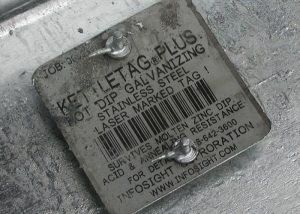
🔥 KettleTag Plus EZ – Built for Galvanising
Specialised metal tags can endure:
- Acid pickling and chemical cleaning
- Flux baths
- Molten zinc temperatures up to 450°C
They emerge fully legible, eliminating the need for re-tagging or manual correction.
🎨 PaintTag & PowderCoat Tag – Built for Coating and Painting
Durable identification remains readable:
- Through aggressive chemical pre-treatment
- After powder coating and curing (up to 538°C)
- Even beneath thick paint layers
⚙️ ShotTag – Built for Shot Blasting
Rugged tag designs withstand:
- Direct cleaning, acid wash, ablative bead, abrasive blasting
- High-impact surface preparation
- Resists common paints, water, solvent, epoxy, enamel, and lacquer
Without losing barcode integrity or data clarity.
🌦 Built for Outdoor Yards
General-purpose industrial tags are designed to:
- Resist UV degradation
- Withstand rain and corrosion
- Survive handling, stacking, and transport
On-Demand Tagging and Digital Integration
One of the biggest risks in traceability is reliance on pre-printed labels and manual systems.
Modern on-site marking and tagging technology enables:
- On-demand printing of barcodes, serial numbers, and job data
- Automatic data transfer from ERP and detailing systems (such as Tekla)
- Elimination of manual data entry errors
- Real-time updates as production changes
This creates a seamless digital traceability chain—from design to dispatch.
Automated Marking for High-Volume Operations
For larger fabrication environments, automated marking systems can be integrated directly into production lines:
- Robotic or inline marking solutions
- Direct marking onto steel components
- Full integration with MES and ERP systems
This ensures consistent, scalable traceability while:
- Reducing labour dependency
- Improving safety
- Increasing throughput
Secure Tag Attachment for Real-World Conditions
Durability doesn’t stop at the tag—it extends to how it’s attached.
Robust fastening options include:
- Wire-on attachment for flexibility and speed
- Weld-on solutions for permanent identification
- Heavy-duty fastening methods for transport and storage
This ensures tags stay with the material throughout its lifecycle.
Protecting Your Bottom Line
A reliable traceability system does more than ensure compliance—it protects profitability.
✅ Reduce Rework and Scrap
Accurate identification prevents costly fabrication errors.
✅ Improve Operational Efficiency
Automation removes bottlenecks and manual processes.
✅ Pass Audits with Confidence
Meet ISO, SANS, and project-specific requirements with clear, verifiable data.
✅ Eliminate Delivery Errors
Ensure every component arrives correctly identified and ready for installation.
✅ Strengthen Customer Trust
Demonstrate quality, reliability, and full accountability.
Take Control of Your Traceability
Traceability failures are not just operational challenges—they are business risks.
By implementing a robust, industrial-grade traceability system, you can:
- Maintain compliance with South African standards
- Improve efficiency across your operation
- Protect your margins and reputation
Ready to strengthen your traceability?
Contact Traceability Solutions to explore how durable identification and automated marking solutions can perform in your specific fabrication environment—and help you eliminate traceability risks for good.